
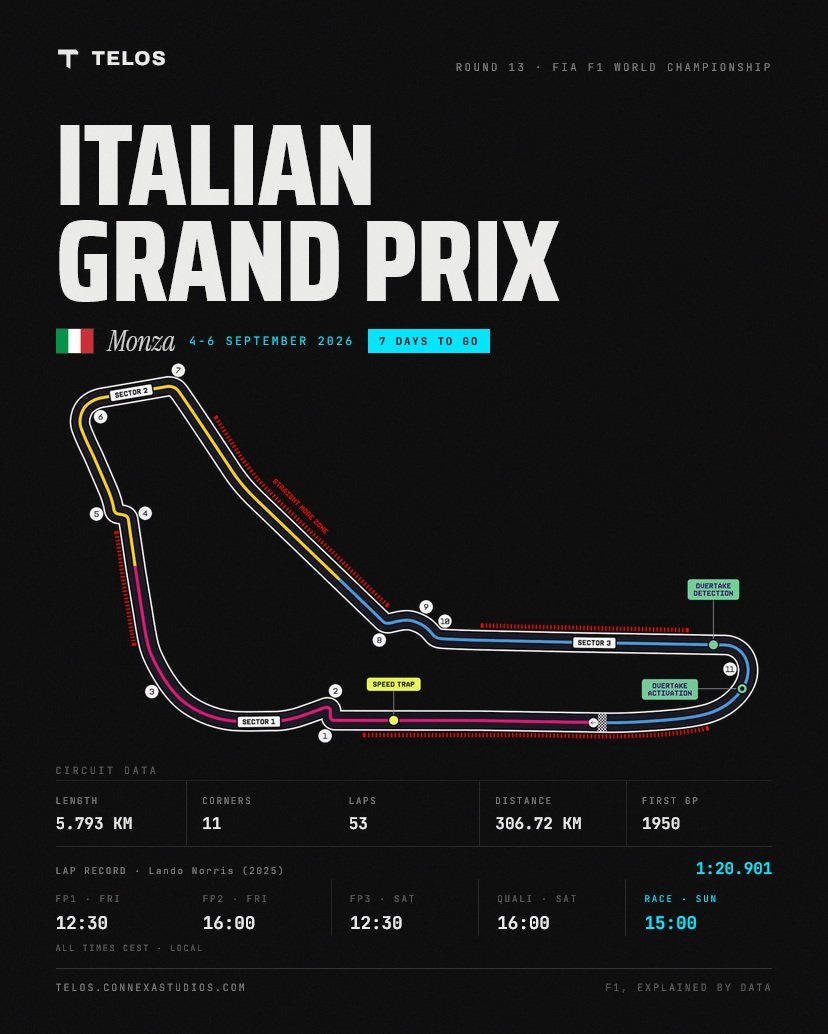
The 13th round of the season will unfold on Monza’s 5.793 km layout, a circuit of eleven corners stretched over fifty‑three laps.
Telos’ model nails the podium 97.1% of the time.
Circuit profile
Monza’s high‑speed character is defined by its long straights and a modest corner count, demanding low‑drag setups and careful tyre management to avoid the dreaded tyre cliff. Drivers will need to balance undercut opportunities with the risk of getting stuck in dirty air behind the leaders, especially as the pit window opens early in the race. The fastest lap ever recorded on this asphalt belongs to Lando Norris, who carved a 1:20.901 in 2025, a benchmark that still stands as a reference for optimal tyre and fuel loads.
Telos model performance
Telos’ predictive engine has logged a winner‑selection accuracy of 68.6% across thirty‑five scored races, a stark contrast to the 31.4% success rate of a random pick. When the focus widens to the entire podium, the model’s correct‑order‑agnostic hit‑rate climbs to 97.1%, underscoring its strength in identifying the top three finishers regardless of their exact sequence. All forecasts are released before the 15:00 local lights‑out on Sunday and are evaluated only after the checkered flag, including any mis‑predictions.
Looking ahead
The upcoming Italian Grand Prix will test both the drivers’ ability to extract maximum performance from a circuit that rewards low‑drag aerodynamics and Telos’ capacity to anticipate race‑day dynamics. With telemetry data and pre‑race probabilities available on telos.connexastudios.com, teams and enthusiasts can explore the granular inputs that feed the model’s forecasts. As the lights prepare to go out, the focus will be on how well the model’s statistical edge translates into real‑time race outcomes, especially in a venue where a single lap can shift the balance between a clean undercut and a costly overcut.