
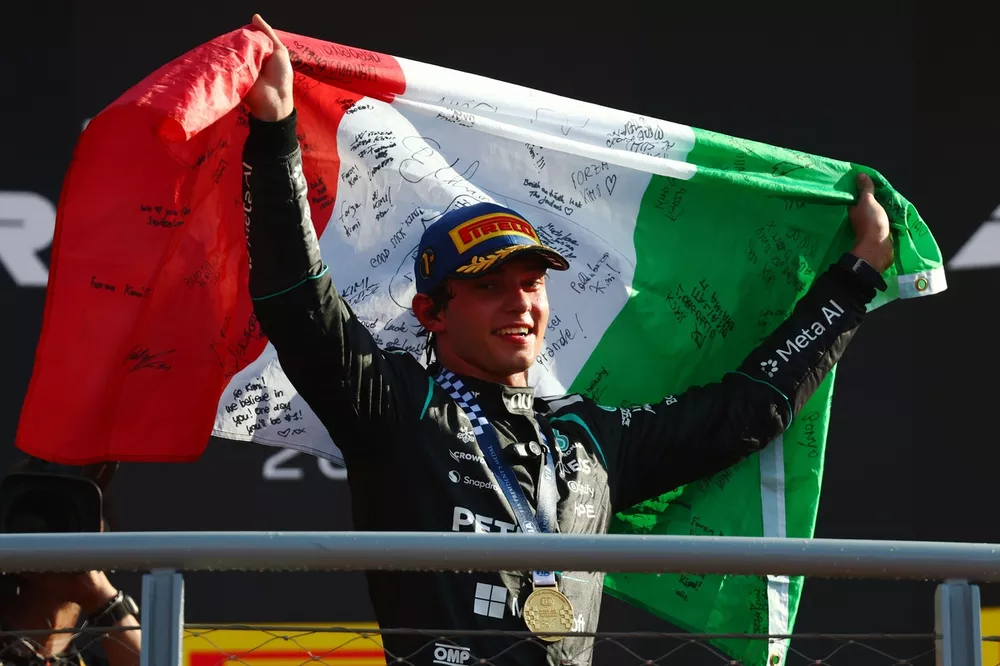
Kimi Antonelli’s 53‑lap run from 19th to the check‑ered flag at Monza was a textbook example of how a single well‑timed pit stop can overturn a deficit, yet also of how the data we can extract from open telemetry stops short of capturing every nuance.
Race Overview
The 2026 Italian Grand Prix began under a red flag on lap 3, a pause that left drivers with a single, short out‑lap before the race proper. From the start, Antonelli was 19th, the furthest from the front, and his team had a 25‑place gain to make up. Over the course of 53 laps he climbed 25 places, netting 18 positions when the final lap count is considered. His climb was punctuated by four lead takes and seven lead swaps, all recorded in the telemetry trace.
The lap‑by‑lap position data shows a steady progression: from 19th at lap 0 to 16th by lap 1.347, then 14th at lap 1.902, and 13th at lap 2.042. By lap 6.447 he was 10th, and by lap 12.315 he had reached 4th. The decisive moment came on lap 18.131, when the trace records a position change to 1st. The following lap, 20.095, shows a drop to 2nd, and a quick return to 1st at 20.323.
Lead Changes
The telemetry records seven lead swaps. The first occurred on lap 18.131, when Antonelli overtook the leader in a clean pass. A second swap on lap 20.323 saw him lose the front to a rival, only to regain it on lap 22.094. The final, decisive lead change happened on lap 50.666, a late‑race surge that sealed the win. Each of these swaps is timestamped in the trace, providing a granular view of the on‑track battles.
The single pit stop at lap 28, lasting 24.9 s, was the linchpin that allowed Antonelli to convert a 19th‑place start into a race‑winning position.
Pit Strategy
Antonelli’s only pit stop came on lap 28, with a duration of 24.9 seconds. The data shows that this stop was the sole interruption in his stint, a fact that underscores the importance of a clean, efficient pit window in a high‑degradation circuit like Monza. The telemetry does not provide tyre compound or degradation rates, but the position trace indicates that the stop did not cost him a lead, as he returned to 1st by lap 30.413.
The lack of additional pit stops suggests that the team managed tyre wear effectively, allowing Antonelli to maintain a competitive pace without the need for a second stop. The telemetry’s position curve, however, cannot reveal the exact tyre strategy or the lap‑by‑lap degradation profile, limiting the depth of analysis that can be drawn from the open data alone.
Limits of Open Telemetry
While the position and lap data provide a clear narrative of Antonelli’s climb, they fall short of capturing the full complexity of a wheel‑to‑wheel lap. The telemetry does not include speed, acceleration, or tyre temperature data, which are crucial for reconstructing the physics of an overtaking manoeuvre. Nor does it provide aerodynamic load or brake bias, both of which influence how a driver navigates the high‑speed corners of Monza.
Moreover, the position trace is a discrete sample taken every 0.04 seconds; it does not capture the continuous motion of the cars or the precise moment of contact during a pass. The data also lacks information on track surface conditions, which can affect grip and tyre wear.
In short, open telemetry can tell us what happened—positions gained, lap times, pit stops—but it cannot fully explain how those events unfolded on the track. For a complete picture, one would need the richer datasets that are still proprietary to teams.
The analysis above is built solely on the publicly available JSON payloads for the 2026 Italian Grand Prix. No additional information was inferred beyond what the source data provides.