
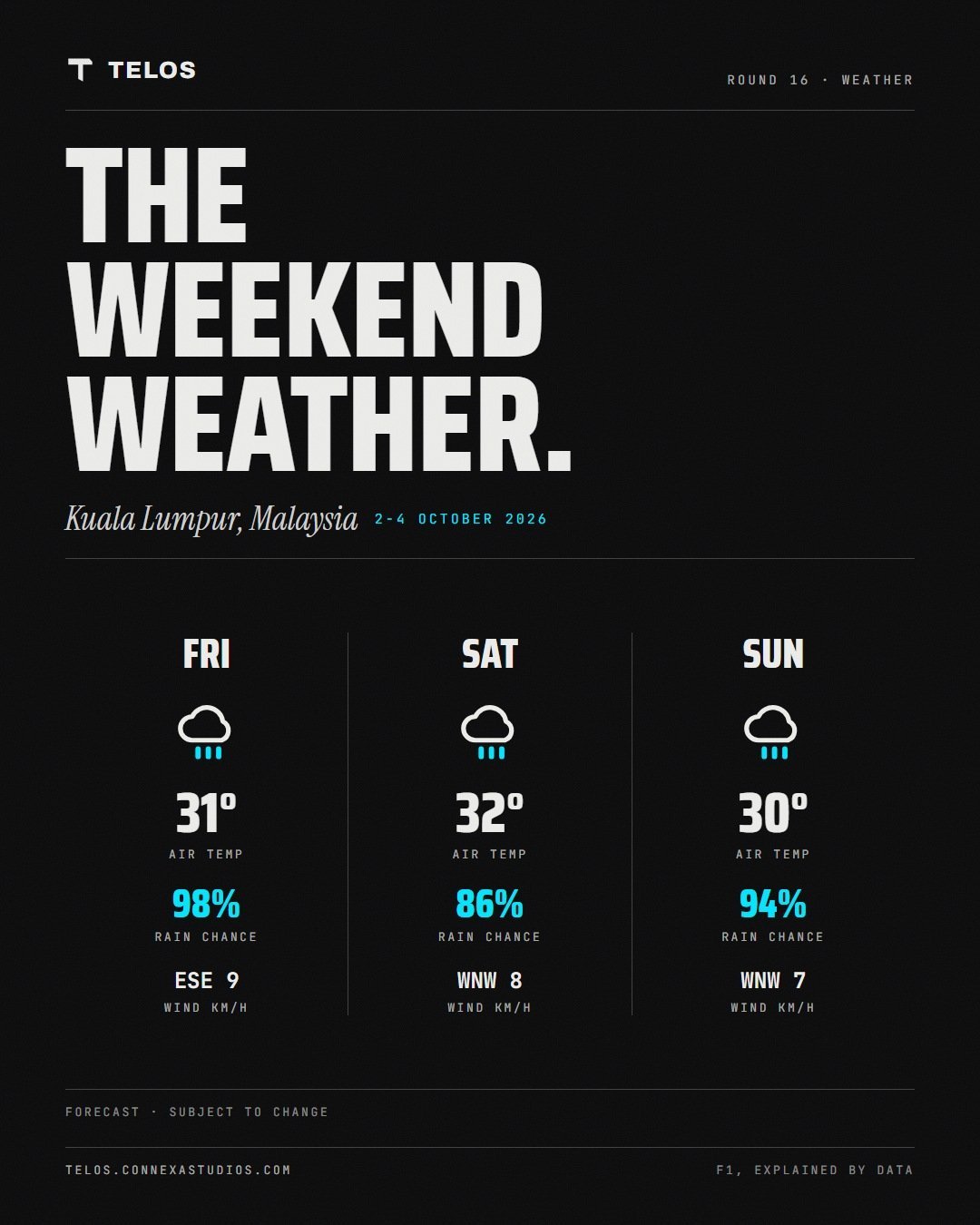
The meteorological outlook for Sepang predicts rain on all three days of the event, with a 98% chance on Friday, 86% on Saturday and 94% on Sunday, while ambient temperatures hover around 31 °C and wind remains negligible.
Qualifying Under the Threat of Sudden Showers
A tropical downpour can develop within minutes, a factor that will heavily influence the qualifying session. Teams will be forced to decide whether to start on slicks and risk an early switch to intermediates, or to gamble on a wet‑compound set‑up from the outset. The timing of the rain will dictate the viability of an undercut versus an overcut, as drivers on a drying line may gain track position while others struggle through the spray and reduced grip. The ever‑shifting forecast means that the usual qualifying window could close abruptly, prompting engineers to monitor the weather radar in real time.
A sudden rain burst can turn a qualifying run into a tyre cliff within seconds.
Race Strategy Shaped by Unpredictable Weather
If the forecast holds, the race will likely be run in wet conditions for the majority of its distance. The negligible wind will keep the aerodynamic balance relatively stable, but the high temperature will affect tyre degradation on the wet compound, potentially shortening stint lengths. Teams will have to calculate the optimal pit window, balancing the need to avoid the tyre cliff against the risk of losing track position in dirty air behind a slower car on a different tyre. An early switch to full wets could lock a driver into a longer first stint, while a delayed change might force an aggressive overcut later in the race.
Model Pick Awaited Until After Saturday
Given the fluid nature of the weather, the predictive model’s pick will be held in abeyance until after Saturday’s session. Once the qualifying results and the latest forecast data are available, the model can adjust its strategy recommendations, factoring in the likely tyre choices and pit‑stop timing required for a wet‑dominant race. Until then, teams will continue to prepare for a range of scenarios, from a fully wet weekend to a brief dry spell that could open a window for slicks.
The combination of high humidity, scorching temperatures and near‑certain rain makes Sepang a classic test of adaptability, where the ability to read the sky can be as decisive as the fastest lap time.